
Experts say most of the rest is out in the North Sea and full recovery is not achievable. Councillors want an independent review of every agency.
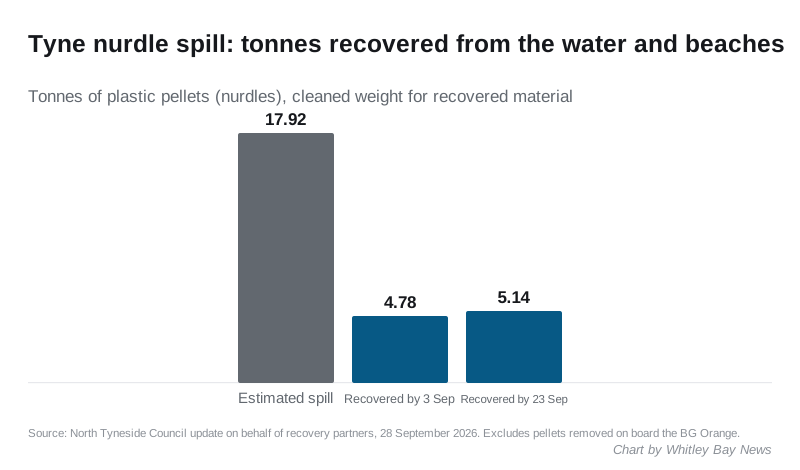
The first verified figures for the Tyne nurdle spill are out. An estimated 17.92 tonnes of plastic pellets entered the sea and river on 19 July. By 23 September, 5.14 tonnes had been recovered from the water and the beaches. (North Tyneside Council)
The expert group advising the clean-up now says most of the rest has probably drifted out into the North Sea. It also says recovering every pellet is “not considered achievable”. The operation is preparing to move beaches from active clean-up to monitoring.
When we last reported on the clean-up, on 19 September, the council said a verified recovery figure was “not currently available”. Our earlier story covers the change of contractor approach and where to take pellets you find.
The figures
The update was published on 28 September on behalf of the partners running the recovery. It gives these numbers:
- 17.92 tonnes: the estimated quantity of nurdles that entered the marine environment
- 4.78 tonnes: recovered from the water and shoreline by 3 September, measured as cleaned weight
- 358.85kg: recovered between 3 and 23 September, which the update says reflects “the much smaller quantities now being found”
- 5.14 tonnes: the total recovered from the water and beaches by 23 September
That total is about 29% of the pellets estimated to have reached the water. The update counts a second figure as well: the pellets the Port of Tyne took out of damaged containers on board the BG Orange before they fell in. Adding those, it says “almost three quarters of the original nurdle cargo” has now been recovered. It does not give the size of the cargo or the amount taken off the ship.
What the scientists say
The Scientific and Technical Advice Cell (STAC) was set up to give the multi-agency response specialist advice. It has reviewed recovery data, shoreline surveys, and modelling by Newcastle University and the government’s marine science agency, Cefas.
Its main findings, as set out in the update:
- many of the pellets are likely to have dispersed beyond the Tyne estuary into the North Sea
- some may still be in the river system
- the number being found on North Sea beaches is now “very small”
- samples from the Tyne river bed have not found deposits there
- nurdles may keep washing up in future, depending on weather, tides and wind
- the modelling cannot predict which beach a pellet will reach, or when
Dr Robert Bradburne, who chairs STAC, said: “Our assessment indicates that a substantial proportion of material is likely to have dispersed offshore.”
STAC has recommended weighing recovery data, monitoring, modelling and shoreline surveys together. The Recovery Working Group is now setting thresholds for when active recovery at a beach should switch to monitoring. It is also deciding what level of fresh pellets would trigger a return. An ecological assessment is still to come.
What the council voted for
Full Council debated the spill on 24 September. The draft minutes, now published, show how it ended.
Councillors L and J Bartoli had moved a motion asking the elected mayor to appoint an independent person to review the council’s own response. An amendment from Councillor H Johnson replaced it, by 30 votes to 19. A further amendment from Councillor T Bailey was then carried unanimously, and the final motion passed by 49 votes to none.
The council resolved:
- to ask the elected mayor to call on the Government to legislate for zero plastic pellet loss, in line with EU law, “without delay”
- to ask the Government for ongoing funding and technical support for the councils dealing with the long-term impact
- to ask the Northumbria Local Resilience Forum for a full, independently chaired review of every agency’s response, and to publish its findings
- to put those findings before an Overview and Scrutiny Committee
- to ask the mayor to establish “clear council led operational control” of the beach cleaning response
- to ask for pollution to be removed promptly after each tide, with same-day updates to paid teams and volunteers
- to set up Beach Management Committees, including community members and ward councillors, to plan for pollution emergencies
- to record the council’s thanks to the volunteers and groups who helped
The final text also records “concerns” that the council’s beach responsibilities, including Blue Flag requirements, “have not been fully discharged since 21 July”. It describes Fish Quay Sands as “particularly severe with tens of thousands of pellets embedded in the sand”. Those are the motion’s words. The council has not published a beach-by-beach survey that we can check them against.
Two similar motions on the agenda were not debated, on the Monitoring Officer’s advice.
Sewage in the Tyne, the same night
The same meeting passed a second motion on the river, by 33 votes with 15 abstentions. It notes two “significant discharges of untreated sewage” into the Tyne in the month before the meeting, while volunteers were clearing pellets. It cites Environment Agency data showing 840 storm overflow spills into the Tyne’s saline estuary in 2025, lasting 5,716 hours in total.
The council asked the mayor to write to the Prime Minister seeking proposals for public or mutual ownership of water companies. It also called on the North East Mayor to convene a regional water summit, and asked for a Water Quality Champion to be appointed from among councillors. The motion welcomes joint work in Cullercoats between the council, Northumbrian Water and the Environment Agency on contaminated groundwater.
What it means for you
- Pellets will keep turning up. The scientists expect more to wash in after storms and big tides, even on beaches that look clear.
- The seven collection points remain on the council’s map, including Whitley Bay beach, Cullercoats Bay, both ends of Longsands and Prior’s Haven. Check the council’s nurdle page before a beach clean.
- Wear gloves and keep dogs on leads where pellets are showing. The council says nurdles are not toxic and the risk to people is very low, but they harm animals that eat them.
- Expect the visible clean-up to scale back at quieter beaches once the monitoring thresholds are agreed. That is a planned change, not the end of the response.
- The review is a request, not a decision. Whether the Local Resilience Forum agrees to an independently chaired review is up to the forum. We will report its answer.
Heading to the coast this month? Our things to do in Whitley Bay guide and parking guide cover the seafront.
Have your say