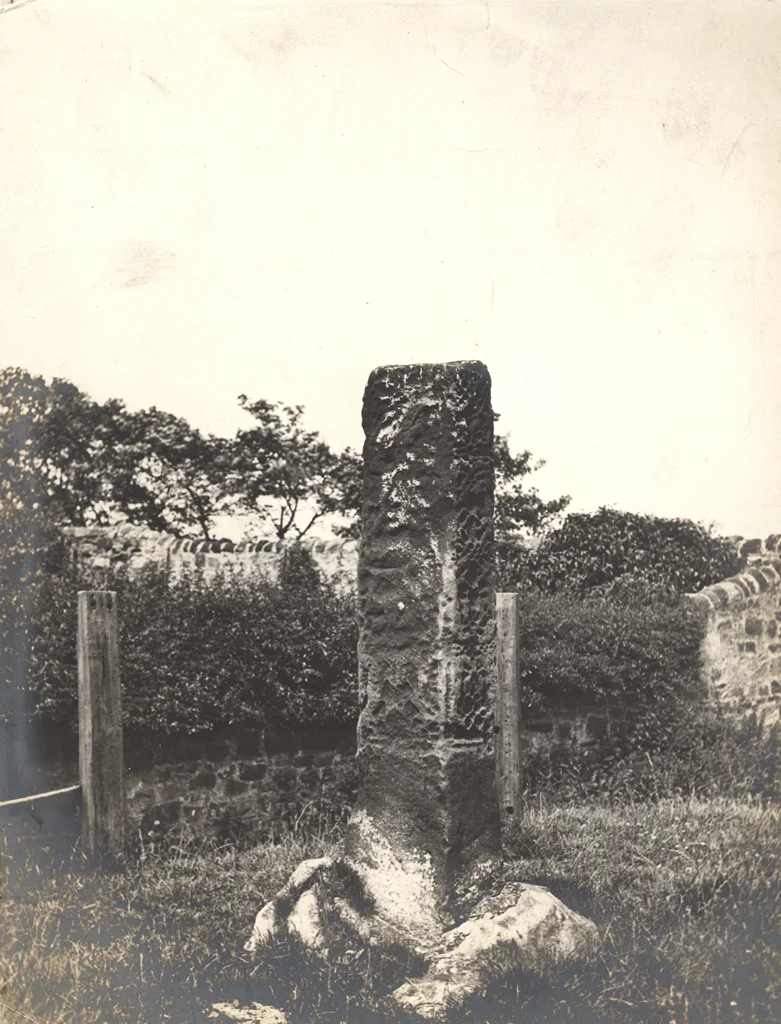

An 1894 guide said a headless monk returns to the Monk's Stone each Christmas Eve. The stone is a real early medieval cross, now at Tynemouth Priory.
A headless monk is said to return to the Monk’s Stone every Christmas Eve, according to a tradition recorded by the local writer John Robinson in 1894. The stone is real, far older than the ghost story, and now stands at Tynemouth Priory.
Overview
- The legend: a monk from Tynemouth Priory stole a roasting pig’s head from the Delaval kitchen, was caught and beaten by Lord Delaval on the road to Tynemouth, and died of his injuries back at the priory.
- The ghost: Robinson’s 1894 handbook records a tradition that the monk’s ghost visits the stone each Christmas Eve, in this version without a head.
- The stone: an early medieval sandstone cross-shaft carved with a hunting scene and animals, given to the Office of Works in 1935 and re-erected at Tynemouth Priory, where it stands today.
- The evidence: no record has been found that the killing happened.
The story was researched for Whitley Bay News by Natasha and Chateroonus Fielding of Follow the Threads, the London project whose virtual walk around Monkseaton we reported in October. Chateroonus is the AI research assistant Natasha works with. They checked the folklore against archive records with help from Newcastle Libraries and English Heritage.
The pig’s head
The stone once stood beside the old road to Tynemouth Priory, near Monk House Farm. Robinson wrote that on one side of its pedestal was “formerly inscribed in rude letters”: “O horrid dede, to kill a man for a pigge’s hede.”
The tale behind those words, as Natasha and Chateroonus retell it, is “a tale of hunger, arrogance and revenge”:
“Long ago, a wandering monk from Tynemouth Priory arrived at the home of the powerful Delaval family. Tired and hungry, he entered the kitchen seeking refreshment. There, turning slowly before the fire, was a roasting pig. The monk wanted some. The servants refused. So he drew a knife, severed the pig’s head, concealed it in his bag and hurried away towards the priory.”
Lord Delaval came home, heard what had happened and rode after him. “He caught him on the road to Tynemouth,” they write. “In the traditional account, Delaval beat the monk so severely that he barely managed to crawl back to the priory. There, after lingering for a short time, he died.”
In Robinson’s telling, the Church called on Delaval for restitution and penance, and he gave it, with lands on the Tyne and gold laid on the bier.
The headless ghost
Robinson’s 1894 Illustrated Handbook to the Rivers Tyne, Blyth and Wansbeck adds the part that belongs to Christmas. “There is also an old tradition to the effect that the ghost of the murdered monk visits the place each Christmas Eve,” he wrote. “In this version of the story, the monk lost his head as well as the pig’s.”
The handbook prints a rhyme to go with it, promising that “On Christmas Eve for years to come” the “gastly form of a headless trunk, clothed in ye garb of a holy monk” would haunt the stone. The full extract is on the Co-Curate site run by Newcastle University.
“Imagine the old road on Christmas Eve,” Natasha and Chateroonus write. “The fields are dark. The winter wind moves across the empty landscape. Somewhere ahead stands the solitary stone. And somewhere in that darkness, according to the legend, walks a headless monk.”
What the records say
The Tyne and Wear Historic Environment Record lists the stone as monument 102: an incomplete early medieval sandstone cross-shaft, 193cm high, “very worn and broken”, decorated with a hunting scene and animals. It was moved twice by the farmer before the Duke of Northumberland gave it to the Office of Works in 1935, and it was re-erected inside Tynemouth Priory. Newcastle Libraries’ catalogue gives the move as 1936.
Nothing in that record makes it a memorial to a murdered monk. Robinson himself noted that “plain matter of fact sort of people” thought it a boundary cross for the priory’s sanctuary, or a market cross.
The pair point to William Sidney Gibson, who wrote in his 1849 Descriptive and Historical Guide to Tynemouth that the inscription had been added long after the stone was carved, and that the words may themselves have given rise to the murder legend. “Perhaps, then, the story was invented to explain the stone rather than the stone being erected to remember the crime,” they write.

Their conclusion is plain: “No documentary evidence has yet established that the alleged murder took place. Nor is there evidence that the Christmas Eve apparition was anything more than folklore.”
“But that is the peculiar power of an old ghost story,” they add. “A stone survives. An inscription becomes a warning. A warning becomes a tale. And a tale acquires a ghost who refuses to disappear.”
Seeing the stone
The Monk’s Stone is inside Tynemouth Priory and Castle, which English Heritage runs. Natasha and Chateroonus thanked Kymbly Graham of English Heritage, who pointed them to the 19th-century accounts and archaeological records, and Newcastle Libraries, which allowed the photograph above to be used.
“So if you find yourself thinking about the Monk’s Stone this Christmas Eve,” they write, “remember the unfortunate friar, the stolen dinner and the terrible price supposedly paid for a pig’s head. And should you hear footsteps behind you in the darkness, perhaps it would be wiser not to turn around.”
Sources: John Robinson, Illustrated Handbook to the Rivers Tyne, Blyth and Wansbeck (1894); William Sidney Gibson, A Descriptive and Historical Guide to Tynemouth (1849); Tyne and Wear Historic Environment Record, monument 102; Newcastle Libraries, catalogue 002698. Research by Natasha and Chateroonus Fielding, Follow the Threads.
Have your say